Download Printable Format (Word.doc)
Download PDF Format
In North America, where our associations with Denmark are likely to extend
no farther than Hamlet, blue cheese and the Little Mermaid, we might
soon find ourselves on better terms with things Danish thanks to the introduction
here of a line of products that could substantially add to the well-being
of our farm animals and the yield and quality of our growing things – from
the fruit and vegetables in our garden patches to crops cultivated on a grand
scale – not to mention our own bodily health. The firm Biosa Danmark
ApS sells its products in over 30 countries around the globe, but is only
now starting to create a serious presence for itself in the New World, with
offices and a distribution network.
The principal Biosa products are three in number, all of them
organic herbal/microorganism blends. The use of microorganisms in treating
the soil or human and animal biology is not new, although agriculturally that
use has been confined for the most part to Asia; and in fact it was while doing
consultancy work in Thailand in 1994 for the Danish ministry of the environment
that Biosa CEO Erik Nielsen was introduced to the potential of microorganisms
in agriculture. The person who performed this service was Professor Teruo Higa,
of the University of the Ryukyus in Okinawa, Japan, and the developer of a
much-used product called EM (Effective Microorganisms – or Efficient Microorganisms, depending
on where it’s produced). Higa invited Nielsen to Japan for an extended
visit, as a consequence of which not only did Higa grant Nielsen permission
to work with the product in Europe, but went so far as to send one of his students
to Denmark for a year to teach Nielsen production processes.
Convinced that he could do even better, Nielsen spent several
years experimenting until he arrived at products that were both completely
safe and exceptionally effective. Terra Biosa is dissimilar to the Asian product
in three ways: the inclusion of certain types of plant life in the formula,
the use of other kinds of sugar in addition to molasses for the fermentation
process, and the different mix of cultures. What Biosa has done, in a word,
is assemble an assortment of plants (medicinal herbs, largely), fermented them
in a combination of selected lactic-acid and other probiotic cultures – and
in the process achieved a degree of effectiveness not approached by the simpler
microorganism strains or blends previously (and still) in use.
The rationale behind the particular herbs and other plants used in the blends
is interesting in itself. Although he was schooled for more strictly financial
pursuits, many of Erik Nielsen’s young years were spent in touch with
the soil, and in time he came to have an important influence on the Danish
organic-farming scene until he proved too progressive for what is at bottom
a conservative society. “I could tell you that this or that herb is known
to be good for one thing or another,” Nielsen said to me when we sat
down for a chat late in the summer of 2003 in Frederiksværk, where the
operation is located, in northern Zealand, Denmark’s biggest island. “And
that this or that traditional medicine recognizes some virtue or quality in
this or that herb. But,” he said, in an admission that will resonate
sympathetically with herbalists everywhere, “I used a particular herb
because it felt right.”
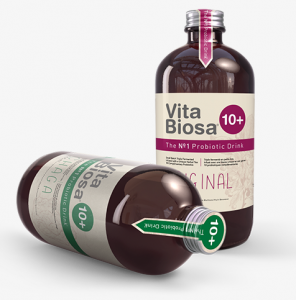
As much as Vita Biosa (for humans) and Animal Biosa are quick to restore the
natural microbial balance in the digestive system, enabling the body to extract
the maximum of nutrients from the food it takes in and providing a basis for
good health generally, so does Terra Biosa increase the biological activity
of soil, speeding the decomposition of organic materials and releasing nutrients
for the benefit of growing things.
As the activity and populations of nitrogen-gathering bacteria in the soil
increase, so do plant root systems and the consequent absorption of greater
quantities of nitrogen, phosphorus and potassium, resulting both in higher
yields and in less need for fertilizer of any kind. And it should be noted
that a complete list of uses for Biosa ranges well beyond these applications,
from the recycling of contaminated earth and the cleansing of wastewater (and
septic tanks) to the more humdrum business of lawn care or the weekly household
laundry. Lastly, and importantly, these mixtures are rich in antioxidants.
In the course of our conversation Nielsen confessed that one of the inspirations for his experiments with microorganisms was that, as he said, “In organic farming” – he meant in Europe, of course – “we always had the problem that we couldn’t produce enough.” With Terra Biosa he feels he has gone a long way towards remedying that situation, and it was in the spirit of seeing for myself the improvements that Biosa has effected that at a certain point I came to be standing with Jørgen Brandt Hansen in the middle of an acre and a half of gardenias near the town of Sabro on the eastern side of Jutland, that part of Denmark that comprises an extremity of the European mainland. Somewhere I’d read that there are 200 species of gardenia, but these all looked alike to me, so I didn’t ask. What I did ask, a little cheekily, was, “Where’d the gardenia obsession come from?
Brandt Hansen didn’t miss a beat. “It was my father’s obsession,” he
said. Then he smiled a little Danish smile. “I just inherited it” – and
I found myself reflecting, not for the first time, on the difficulty of making
the mental connection between the Danes of today – easy-going, with an
impish, stutter-step sort of humor – and their Viking ancestors, who
plundered, marauded and burned wherever they set foot, especially since as
a people, Danes are virtually unchanged in four millennia. A Danish schoolmate
of mine, way back when, put it to me – in an agricultural metaphor, appropriately – that
the Danes simply sowed their wild oats a little earlier than most modern bloodlines.
Jørgen Brandt Hansen inherited more than a mere obsession: along with
it came two greenhouses totaling almost 65,000 square feet in which he raises
300,000 gardenias at a time – a year’s worth of sales – for
export to various points in Europe. But more than that still, he was bequeathed
his father’s commitment to Terra Biosa, the elder Brandt Hansen having
been the first to make use of Biosa in indoor floriculture, and the benefits
have been considerable.
First, gardenia cuttings get a good head start by being dipped into a solution
of Terra Biosa and an organic aphid treatment. Brandt Hansen adds Terra Biosa
to recycled water that flows through the tables the gardenias sit on, each
in its individual pot, in such a way that the water doesn’t come into
contact with the upper part of the plant, lessening the risk of leaf rot. But
the plants don’t suffer from root rot anymore, either. Before
Terra Biosa was introduced, Brandt Hansen’s greenhouses were losing anywhere
from 20 to 40% of their product. After one year of Biosa use, that percentage
had dropped to five, and is now at virtually zero. In addition to the increased
financial profits he derives from a full complement of vigorous plants, Brandt
Hansen is saving between one and two full weekly salaries for employees who
once did nothing but remove dead leaves and chuck out lifeless or dying plants.
One more thing about Jørgen Brandt Hansen’s growing system. To
oxygenate his recycling water he uses a device called a BioReco, which I’d
already seen in action in a very different setting, on a dairy farm outside
the village of Wilster in Schleswig-Holstein, one of Germany’s northernmost
regions and fittingly once Danish territory.
It happened that at times on my travels in current Danish territory I would find myself following in the footsteps of Sacheverell Sitwell, of the poetic English family, who in the mid-1950s spent part of a summer seeing the Danish sights. About his traversal of the country’s second largest island he wrote, “The reader must try not to tire of castles and country houses, for there is not much else in Funen.”
But Sacheverell never met Knud Dencker-Jensen, who lives a few miles in from
Funen’s south coast. If it weren’t for a digital camera always
at the ready, Knud with his perpetual half-glasses, kindly expression, husky
voice and supply of hankies would possibly put you in mind of a good-hearted
creature from some Scandinavian folktale, but in fact Knud is a Biosa executive/consultant,
and perpetually on the move.
Where he moves to depends on the location of whoever has a problem to sort
out and whose interest has been piqued by the possibilities of Biosa. Knud
goes simply to make suggestions, and in Wilster he came to make suggestions
to the Langholz family – Thomas, Uta, Thomas’s father, Reimer,
and three offspring as scrumptious as kids raised on dairy farms are supposed
to look – who had a very big problem. The rooms of their house, first
of all (including the kitchen, alas), stank of cow manure, and flies were everywhere,
not surprising when you consider that the family home adjoined a barn where
dung was deposited with regularity.
But in the fall of 2000 Uta stumbled on a magazine article dealing with microorganisms,
and a little Internet research led her to Biosa. Thomas called the firm, along
came Knud – and as he reports the case, the initial conversation can
be boiled down to this:
Thomas: The house stinks of manure.
Knud: Manure is money…[pregnant pause]…and money smells not.
This possibly sounds better in the original German: “Gülle ist Gelt…und
Geld stinkt nicht.” In whatever language, it was a mantra of Knud’s
I would get to hear him intone on more than one occasion.
(One of the spots on the globe where I didn’t get to hear the
mantra but where Knud’s travels take him is Malaysia, where many Muslims
raise pigs – not for their own consumption, which is forbidden, but for
sale to the country’s Chinese. But just as for reasons of their faith
they can’t consume the flesh of the pigs, neither can they use the pigs’ manure
as fertilizer. So they dump it in the river. Knud is helping them compost the
manure with Biosa, for subsequent export to Vietnam, China, India and Australia,
providing at one and the same time a use for a product, a means of income for
people [“Gülle ist Gelt…”] and a reduction in environmental
damage.)
Knud left the Langholzes with a supply of Terra Biosa. The manure got sprayed,
the barn areas in general got sprayed (to keep harmful bacteria to a minimum
and provide a more agreeable indoor climate), and the cows got sprayed. When
eight days later Knud returned, the smell was gone.
But the Langholz family, and other farmers in the area, had a bigger problem
than unpleasant odors. These are marshy lowlands (a sign marking the lowest
point in Germany, 3.8 meters below sea level, is no more than a long walk from
the Langholz farm), and not only had the soil been poisoned by chemical fertilizer
residue, but so had the system of canals that supply water to it. Most area
cattle were suffering from lesions of the liver, among other ailments. The
water at the Langholz farm was found to contain an ammonia rate of between
15 and 16 milliliters per liter.
A ditch was dug to accommodate a pond of a little over 20,000 cubic feet, and
the water to fill it was pumped from a canal 200 yards away. To oxygenate the
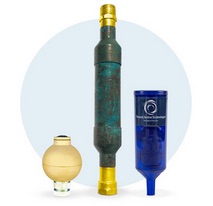
water in the pond, a BioReco was installed. This equipment, produced for Biosa,
is often used in conjunction with Terra Biosa in the treatment of unhealthy
bodies or supplies of water. The device is based on the theory that in clean
water, water molecules move in an endless whorl. In polluted water that movement
is reduced, resulting in lower oxygen and energy content. The BioReco draws
in air from the atmosphere and reintroduces or bolsters the whorl pattern,
raising oxygen content not just near the surface but at deeper levels and,
given a reasonable depth, at the bottom as well, yet without stirring up sediment
and mud – in fact the increased oxygen, especially in combination with
Biosa, helps compost the mud, contributing to the health of the water still
further.
A healthy water environment in a natural balance is what Biosa aims at, just
as it aims at a natural balance of flora in the digestive system of both man
and beast. Terra Biosa is effective for example in restoring a healthful bacterial
balance in water afflicted with an overabundance of nutrients and abnormally
extensive algae growth, first by transforming nitrates into nitrogen and oxygen,
which escape into the air, with algae growth dropping as a consequence of diminished
nitrogen content, and secondly by competing for space with the anaerobic microorganisms
that produce methane and hydrogen sulphide, contributing to an environment
that favors the production of beneficial bacteria and fungi.
The process can call for experimentation, given the number of factors potentially
involved: the source, quantity and nature of nutrient supply, the amount of
sunlight and the angle it comes from, the extent and type of vegetation both
in and adjoining the body of water, the presence or absence of fish and which
species (some feed on plant life that absorb nutrients and release oxygen,
or on those tiny daphnia crustaceans known as “water fleas” that
are found in all manner of freshwater areas and that feed on algae), and so
forth.
And in the particular situation of the Langholzes, in addition to the BioReco,
every day for two weeks 10 liters of Biosa were added to the pond, which became
the source of drinking water for the Langholz cows. Analysis, at the end of
this period, showed no trace of ammonia whatsoever, and nitrate and phosphate
rates at only two milligrams and 0.5 milligrams per liter respectively.
Concurrently, each cow received a daily dose of 100 milliliters of Animal Biosa
in its feed. Health problems decreased – the Langholzes discovered, as
many other farmers have done, how much Biosa can end up saving them in reduced
veterinary expenses – and in time not only did milk production rise,
but the milk itself improved dramatically in quality: the white-blood-cell
count, which had been as high as 600,000 per milliliter of milk, well over
the European legal limit of 400,000, after six months of Biosa use dropped
to as low as 150,000, eventually leveling out at an average of 250,000 to 300,000
units. And the diarrhea problems that had afflicted as much as 60% of the cattle
disappeared.
It should be noted at this point that a little Biosa goes a long way. A liter
of Terra Biosa retails for about $30 U.S., Animal Biosa for around $33, but
for applications of any scope, Biosa products are activated and extended in
such a way that the resulting proportion of microorganisms resembles that found
in the one-liter or five-liter container. One liter of bottled Biosa becomes
about 35 liters of activated product, and the activation process is quite simple:
to produce just over 100 liters, in a clean plastic drum three liters of organic
sugarcane molasses are dissolved in 100 liters of lukewarm water. Three liters
of Biosa are added to the mix, which is stirred well and then covered to maintain
an oxygen-free environment. The mixture is kept at around body temperature
for five days (an aquarium heater is the instrument of choice), after which
it is stirred to release carbon dioxide, and surface scum is removed. Another
three days completes the activation process, and the qualities of the activated
Biosa will be retained for as long as a month if it’s kept airtight,
out of the sun, and reasonably cool (50 to 60 degrees Fahrenheit).
The Langholz herd consisted of 63 cows when I was there, a combination of black
and white Frisians and Rotbunte (German Red Pieds). It was the first
time I’d been in immediate contact with manure that had no smell. But
more than that, it was my first time seeing cows that looked so sleek and fit – and
that had no flies. To someone who’d had a hard time picturing a
cow whose head wasn’t swarming and whose tail wasn’t constantly
flicking away at a horde of pests, this was almost an aberration of nature.
The Langholzes discovered that collected manure treated with Terra Biosa (and
note that the manure from animals getting Biosa with their feed is already an
improved and more beneficial product) generates more clover for the cows’ diet
when it’s sprayed on fields where they’ll be grazing, and Animal
Biosa also goes on the hay that is mixed with clover and siloed for winter
feeding. The corn planted in treated areas also improved, providing bigger,
wrinkle-free kernels.
Back in Denmark, the Bigård farm, not much up from the border with Germany,
is operated by Frede Larsen. Larsen farmed traditionally for 13 years, but
has been organic for more than 25. In 1996 he saw Erik Nielsen and Knud Dencker-Jensen
on TV, was sufficiently stirred to buy one liter of Terra Biosa, sprayed it
on some cukes and tomatoes, and liked the eventual results enough to make it
an integral part of his farming.
He grows – well, what doesn’t he grow: it’s that A-to-Z catalogue
that seems popular with many organic farmers: celery root, potatoes, carrots,
beets, onions white and red, herbs by the dozen, celery, tomatoes, eggplant,
fennel, English cucumbers, peppers, squash, leeks, arugula – among other
things – and pumpkins. That an individual plant of Larsen’s had
produced 48 pumpkins in a single season I found remarkable enough, but it slowly
sank in, as I pondered a few examples that had been kept aside and were now
displayed on a high shelf in the boutique that Frede and wife Jane run on the
property, that not just were they handsome specimens of pumpkin, but these
particular ones had been sitting here for two or three years and showed no
sign of decomposition.
This is testimony to the antioxidant properties of Biosa, Larsen told me. Since
he began applying it – Larsen irrigates his greenhouses weekly with Terra
Biosa, spreads treated silage over fields both after harvest and in March,
machining it into the ground, and sprays his fields every spring (again, a
little goes a long way: for normal spraying, it takes no more than thirty liters
of activated Terra Biosa, in turn mixed with whatever quantity of water is
necessary, to cover an entire acre) – not only are his yield and quality
both up, but so is the longevity of harvested crops.
The pumpkins are an obvious example, but he gave me another: of carrots picked
the previous summer, in earlier times 50% would be unusable for human consumption
by April; now with Biosa, the percentage is no more than five. And indeed,
the carrots he brought up from the cellar and that he’d stored there
a year earlier were virtually unaffected by the passage of time, still firm,
redolent and sellable. Frede Larsen is an example of a European organic farmer
who’s found that with the addition of microorganisms to his growing practices
he can produce a crop so bountiful that the price to the consumer of an organic
carrot – or tomato, or pumpkin – is no higher than that of these
vegetables’ non-organically raised counterparts.
A little sidebar: Larsen’s a thinking man’s farmer, and has evolved
a method of dealing with Kortstråle, a variety of galinsoga
that springs up mainly where more desirable vegetation has been planted in
rows. He dries a quantity of the weed, soaks it in water for two to three weeks,
removes and mixes it with a Terra Biosa solution, then sprays the affected
area with the mixture. The galinsoga does not reappear, and Larsen reckons
the solution gets the message through to the soil that there’s enough
of those molecules now, there’s no room for more.
This is quite different from the “orthodox” way of using Biosa
in weed situations. The idea here is for the farmer or gardener to apply the
product in order to paradoxically encourage weed growth – treating
the soil as though preparing it for seeding or planting – but doing so
before the normal growing season so that the weeds can then be “harvested,” leaving
an at least relatively weed-free medium for raising more advantageous plant
life.
One of the more interesting stops, for a non-Dane, was at Båring Højskole
in northwestern Funen, part of the “folk high school” system in
Denmark, which takes a little explaining. The concept was evolved by the 19th-century
Danish theologian N.F.S. Grundtvig as a way for the common people to learn
about their religion, history, and cultural heritage.
These schools have next to nothing in common with North American high schools:
the student body consists of young adults who are at school fulltime, living,
studying and working with their teachers seven days a week, in an atmosphere
that resembles home. The schools have no special entrance qualifications and
no exams, and are open to applicants from elsewhere in the world (there were
young men and women from the U.S., Israel and Japan when I visited), with an
emphasis on students learning from one another. At the core of its philosophy
is the idea of training people for life in democratic circumstances – and
in fact it’s been said of Grundtvig that more than anyone else, through
his educational and also his political endeavors, he laid the foundation for
Danish democracy.
In the agricultural component at the school, everything is organically based – the
students eat organic – and the use of Biosa, ever since the school was
introduced to it by a neighboring farmer, ranks high in importance. A watchword
is sustainability. And the Båring school as it happens is one of the
players in spreading the Biosa word around the world, since the school, which
headmaster Bjarne Ottesen describes as “an international bridge-builder,” runs
or has run agricultural projects in countries as diverse as China, Romania,
Iran and Pakistan. Those seeking their guidance have inevitably been eager
to incorporate the use of Biosa and of BioReco into their efforts.
Hearing this from Ottesen I was reminded of something Niels Wandler had told
me earlier. Wandler ran the Biosa operation in Germany, to date the largest
market for the products, before setting up the North American division. He’d
said there are three mindsets when people are faced with a new way of doing
things. There can be reluctance, there can be acceptance, or there can be a
simple let’s go for it. Denmark’s stance vis-à-vis Biosa,
he’d said, is one of acceptance, albeit in fits and starts. Ottesen was
less generous: “The Danish government looks at money before the environment,” he
told me, “and our school is at cross-purposes with that. And what we
seek is to counteract the basically conservative Danish farming mentality.”
But developing countries are often quick to adopt the third attitude: a) what
have they got to lose, and b) they often have no well-established biases to
overcome. In 2001 a contingent from the Punjab, in India, had spent time at
Båring studying Danish organic methods. It occurred to me on hearing
this that, with the consequences of the leak at the Bhopal pesticide plant
still very much a reality more than 20 years after that calamitous event, the
worst industrial catastrophe the world has suffered, India would seem to need
little in the way of incentive to seek alternatives to agricultural chemicals.
In its communications Båring Højskole refers to the “active
and holistic environment” provided by folk high schools. Almost a year
later, on another continent, in the town of Aldergrove in southern British
Columbia, in a pub at the end of a day on the road, Knud is outlining for me
his personal professional evolution. It’s a journey that describes a
full circle, in that Knud says he now finds himself putting into practice the
values of Rudolph Steiner, whom he had read as a young man.
In the Austrian philosopher-scientist’s Biodynamic agriculture movement,
a holistic system of farming and gardening regards the earth as a living organism.
And soil renewal aimed at the production of vital and deeply nourishing food
is essential. Steiner, were he still with us, might not be a happy man.
Every indication is that the nutritional value of what we grow, its vitamin
and mineral content, is plummeting. And the Food and Agriculture Organization
of the United Nations reports that not only is something in the order of 25
billion tons of valuable upper soil lost every year in the world through erosion
and the effects of weather, but that “only 11 percent of the world’s
soils can be farmed without being irrigated, drained or otherwise improved” in
the first place. Much of the earth’s earth needs a boost, in other words,
and while organic farming is already contributing by helping build healthy,
moisture-retaining soils and by collaborating with nature to replenish those
soils, a holistic approach would seem to be a sine qua non if we have any hope
of enjoying a mutually beneficial relationship with the planet and with its
creatures.
Consider bees. Bee populations are in decline worldwide, an important reason
being a weakening of their resistance to disease and parasites caused by exposure
to pesticides and fungicides. Could anything be more irrational, then, than
to shovel still more chemicals on the problem? And yet, traditionally, chemical
agents have been the weapon of choice in the battle against bee afflictions.
What these have generally accomplished has not been to cure disease but merely
to suppress it, while pests develop resistance to agents used, and discouragingly
quickly.
Olav Rasmussen, an agriculture consultant stationed in the Danish town of Skejby,
has written: “Through sterilization, new infections are acquired, and
so it becomes necessary to sterilize again. But with microorganisms we go in
the opposite direction and try instead to change the balance, so that the harmful
bacteria find poorer conditions.” The microorganisms in Biosa are now
making inroads among beekeepers in Europe and taking first steps with their
North American counterparts – and possibly not a moment too soon: the
potential decrease in the extent of pollination and the consequent drop-off
in crop production that would accompany a continued reduction in bee populations
is alarming to contemplate.
The use of Biosa in beekeeping involves less of looking at a morbid situation
in isolation and more of studying a problem in its context. Underlying this
use is the realization that healing ideally should come from within. And key
to dealing with that problem is the recognition that, first, a well-functioning
immune system enables species to rebuff attacks on vital body functions, and
that, secondly, the quality of the immune system depends to a considerable
degree on the quality of a species’ environment. Informed beekeepers,
therefore, have not been treating just their hives with microorganisms – the
technique consists essentially of spraying a 50/50 solution of Animal Biosa
and unchlorinated water on the hive’s entrance board and inner surfaces – but treating
the bees’ collecting area as well: woods, orchards, fields, even
the water in area ponds and marshes. (The bees can be sprayed with the same
solution to calm them, incidentally, thus doing away with the need for smoke.)
The Moselle River has a longish run through France (though the grapes grown
along its banks there produce nothing nobler than vin ordinaire) and
a stretch in Luxembourg (where grape quality picks up considerably), before
entering Germany and making its way to Koblenz to join the Rhine. It’s
on the twisty German leg of the river’s course where true wine excellence
is found, where Riesling grapes benefit from a schistose subsoil – decomposed
rock absorbs daytime heat and releases it at night to the vines – and
where they’re eventually transformed into the Moselle Valley’s
most famous product.
And nowhere could I find a better spot for making a Biosa-relevant side-by-side
assessment than in the vineyards where Peter Konz grows grapes for his prizewinning
Konz Saar Riesling. Konz is of an old area family, so his vines are located,
not coincidentally, just outside a small town also known as Konz, which sits
near the confluence of the Saar and Moselle rivers about five miles west of
Trier, home to the finest Roman architectural relic in Germany and the birthplace
of Karl Marx.
Peter Konz is ökologisch and then some: “Even organic fertilizers
I have not used since 1995,” he tells me. What he has used is
a homeopathic-type energy-function solution he produces himself under license – and he’s
been sold on the virtues of Terra Biosa for some time. Konz grows on five acres
in the midst of a larger area used by both traditional and organic vintners,
with nothing more than a narrow pathway between individual properties, so comparing
the results of this, that and the other method is an easy task. (Fortunately
for Konz, parenthetically, his vineyards sit upwind of the traditionalists
and their chemical sprays.)
The differences between Konz’s vines and grapes and his neighbors’ were
an eye-opener. The leaves, first of all, were more vital – they had a
different color, even dissimilar shape, and they had an almost palpable energy:
they reach for the sun – while those on the chemically treated plants
were dwarfed by comparison, their duller green gone to yellow and brown where
fungus had been eating away. The grapes themselves presented another stark
contrast: in size, in quantity, in juiciness, in the number of successful individual
examples as opposed to clumps of wilted fruit.
The organic neighbors, meanwhile, had, in varying degrees, less of the fungus
and generally more grapes to the vine than the chemically-treated areas, but
fungus was nonetheless still an obvious problem, and a substantial proportion
of the fruit showed signs of a struggle, not always a successful one.
Peter Konz harvests two weeks earlier than his neighbors, and in his recent
yields the sugar rate of his grapes has climbed by one to 1.5% – which
means higher alcohol potential, which in turn means a higher price for the
crop.
But even without examining the vines and grapes, you could see the difference
in the soil. Konz’s was softer, darker, and to the eye alone more nutrient-rich
than any other. And it was moister. Readers may recall that much of Europe
had a terribly long hot summer in 2003, but Konz’s soil was able to preserve
a healthy water content throughout. And when a heavy rain did finally come,
the water in his various neighbors’ fields ran off, but on Konz’s
was absorbed and remained in the ground. His soil, he reckons, holds 200% more
moisture than it ever did before.
Peter Konz wasn’t sure how long each of his organic neighbors had been
chemical-free, but in making my visual comparisons I thought of some numbers
Knud had earlier shared with me. In his extensive experience, he’d said,
when you abruptly switch from chemical fertilization to organic methods, without
the helping hand of Terra Biosa, crop production over the next several years
tends to describe a roller-coaster ride: in the first year it’s likely
to climb to levels a little higher than the year before; in the second year
it will resemble the old levels; in the third year it drops by as much as 40%;
while in the fourth, fifth, sixth and seventh years it slowly climbs back to
earlier levels. When the use of Terra Biosa is combined with the transition,
however, production increases from the start of the changeover, and
remains at elevated levels. Comparison of the raw material for Peter Konz’s
acclaimed Moselwein with that of his organic neighbors seemed to bear
out Knud’s mathematics.
Rob Donaldson’s Bradner Farms is located northwest of Abbotsford, in
British Columbia’s majestic Fraser Valley area (said Knud, as we drove
at one point through a particularly imposing stretch, with steep tree-lined
inclines as far as the eye could see, “Everything is so big in
Canada”). It’s an organic cow and chicken operation with 1,000
or so Holsteins, some 330 of them active milkers.
Donaldson and Willy Fitzl, who oversees the milk-cow operation, had been persuaded
that the addition of Animal Biosa to the cows’ diet might be worth the
small gamble. The cows’ winter feed consists of a preparation containing
peas, corn, barley, flax meal, a little soy meal, vegetable oil mostly soy,
kelp and a multivitamin and mineral mix; in warmer weather the rations account
for 40% of their feed, with the rest coming from grazing.
The plan, in order to gauge the Biosa impact as accurately as possible, was
to wait for the tester from the Holstein Association to visit the next week,
begin introducing Biosa into the feed, and then compare the results of the
tester’s work with those when he returned some three or four months down
the road. Knud recommended that enough activated Animal Biosa be added to the
rations so that each cow receive 100 milliliters daily (a cost of roughly 10
cents per cow per day), the formula to be diluted somewhat after a certain
amount of time – because of the successful establishment of healthy intestinal
flora in the animals’ digestive systems – to 70 milliliters, for
a cost of around seven cents per cow per day.
Knud had generalized to me that improvement in milk output for cows on a Biosa
supplement can be as much as 20%. That figure applies to underperformers; in
the case of well maintained and organically fed animals like these the hope
was for something in the neighborhood of 10% over time. The farm wasn’t
impatient enough to expect results after the first interval; they figured the
nominal investment was worth a six-to-eight-month wait. But: on the
tester’s return visit in November, July’s average output per cow
of 67 pounds per day had risen to 74 pounds per day, a difference of over 10%
after less than three and a half months. In addition, milk-fat content was
up in an even greater proportion, from around 3.5% to 4%. (Fitzl estimates
that the increase in rations over pasturing might also have contributed to
the rise in milk-fat, though “maybe not.”)
But important though these numbers are, Fitzl enthuses at least as much over
the state of the Bradner cows’ overall health, which he reckons to have
improved by a minimum of 50%. That change for the better manifested itself
most notably in the cases of mastitis, which have dropped in half, with most
instances that do materialize proving to be much milder than before, to the
extent that they can be treated homeopathically.
The chicken part of the operation was not functioning when we visited in July
2004, their stock having been some of the 17 million area birds destroyed in
light of the avian influenza outbreak. It’s since started up again, and
the thinking is that in time Animal Biosa will likely be added to the poultry
feed as well.
But Willy Fitzl has chickens of his own, and his enthusiasm carries over to
the effects of Biosa on the organic egg operation of more than 2,000 layers
run by himself and wife Monica in the same area but just a long stone’s
throw up from the U.S. border (and far enough away from the bird flu outbreak
that the Fitzls were spared the loss of their hens). Around the time that the
Bradner cows started getting Biosa in their feed, the Fitzls began using Terra
Biosa on their own farm, where in addition to the chickens they tend a young
walnut orchard of over 800 trees.
In the laying houses, where previously it was hard to stick a head in without
a mask because of the reek of ammonia emanating from manure, that manure is
now being sprayed, and to dramatic effect: Finzl reports, first, that the ammonia
odor is gone. (Ammonia is produced when the organic nitrogen compounds in manure
decompose; Terra Biosa, in lowering the manure’s pH, retains the nitrogen
and eliminates the smell. The possibilities for Biosa use simply as an odor
eliminator in pig and mushroom operations, for example, would seem to be as
vast as the quantities of manure those operations either produce or consume.)
He also reports that the manure itself is quite transformed in consistency,
from a liquidy accumulation that stuck to boots and clumped on chickens’ claws
to a much firmer mass, with a feeling underfoot like forest moss, thick and
spongy, and minimally moist. It’s being compressed and solidified – compost
is happening.
Gone are the masks. (Spraying the air with Biosa also quiets the dust in an
enclosed space, and can have a similar effect on the animals spending time
there, reducing aggressiveness in those that are prone to it for whatever reason.)
The manure can be scraped up as before or simply covered with sawdust for however
long, meaning the necessity of regular mucking out is gone too. Willy Fitzl
intends spreading his manure, as he does every spring, between the rows of
their walnut trees, but this time will add additional Biosa once the manure
is on the ground.
Still in the same neck of the woods but a little father north, in Fort Langley,
we stopped in at Ponder Park Stables to check on the progress of a horse named
Spin a Tune, better known as Ricky. A couple of months earlier, stable manager
Lisbeth MacQuarry had met Niels Wandler at an area health-food store where
MacQuarry had gone in the hope of finding an organic preparation to restore
some of Ricky’s old energy.
The 13-year-old mount had developed a dull coat, and was constipated and listless
to the point of hardly moving. Wandler convinced her he might have just the
remedy, and after a transatlantic cell-phone call to Knud to check on dosage – Knud
advised that the animal be given a full liter-bottle of Animal Biosa to drink,
another liter 24 hours later, and 10 milliliters a day thereafter – the
process was begun. Ricky started unburdening himself an hour or two after the
first bottle, and produced another five loads over the next 24.
When we caught up with him, he was fit, very mobile, and – in stable
owner Marilyn Boswyk’s words – had “regained his old vigor.” I
caught Knud smiling his doubly pleased smile at the results of his long-distance
counsel, an expression I’d seen before, one part happiness over the product’s
success, another over an animal’s relief. But Boswyk and MacQuarry brought
up a different concern with Ricky, what they’d found to be a hypersensitivity
to being touched or to being groomed with anything but the softest brush. He
was ticklish, in other words, though that condition too had lessened
in severity with continued Biosa therapy. Still, Knud suggested an additional,
external, treatment, namely that the horse be ridden until well lathered up
and that Biosa then be rubbed over his coat, a process that would break down
the remains of insect life lodged next to the animal’s skin. (This, to
my knowledge, was never done, from what I gather because Ricky has since made
so much progress in the matter of his ticklishness that it hasn’t been
considered necessary.)
Later I found myself in a car driving down Fraser Highway with Barrie Briggs. Briggs is an old hand in food wholesaling in western British Columbia who’s joined the Biosa family as a representative. “You know,” he said to me, “I’ve been waiting all my life for products like these to come along. This is important,” he said. “This is something that matters.” And my mind went back to our friend Sacheverell Sitwell, who despite never having met Knud Dencker-Jensen – or Erik Nielsen, for that matter – appeared to me to have summed up with uncanny prescience the potential impact of Biosa when he wrote, “Danes seem to have solved of instinct some of the more terrible and besetting problems of living in the modern world.”